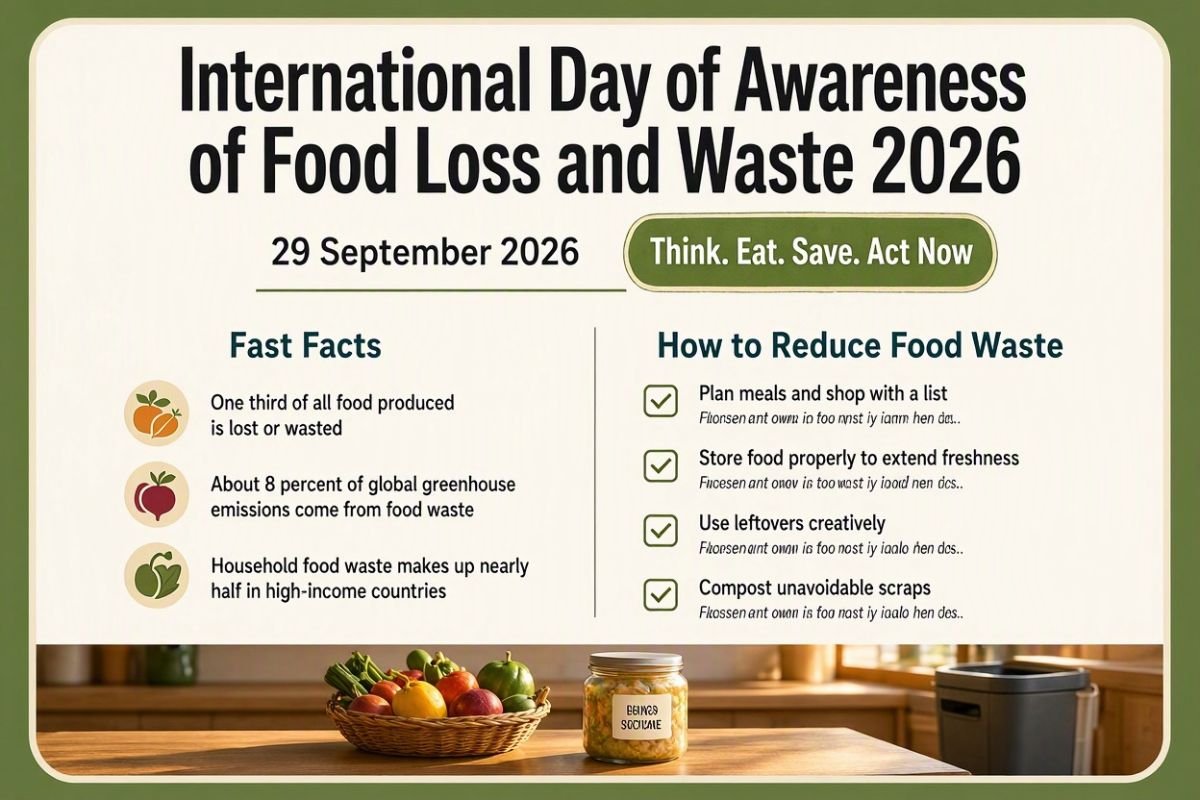
Every year on September 29, the world marks the International Day of Awareness of Food Loss and Waste (IDAFLW). In 2026, the observance falls on Tuesday, September 29, marking the seventh year the day has been recognized, with this year’s theme centered on the “Transformative Potential of Reducing Food Loss and Waste.” At its core, food loss and waste refers to food that decreases in quantity or quality along the food supply chain, from harvest through retail and consumption. This can happen when food is damaged or spoiled before reaching consumers, or when edible food is discarded at the retail, food service, or household level.
This guide covers when the day falls in 2026, what this year’s theme actually means, the latest global statistics on food waste, the real difference between food loss and food waste, and practical ways to cut down on waste at home.
When Is International Day of Awareness of Food Loss and Waste 2026?
International Day of Awareness of Food Loss and Waste 2026 will be observed on Tuesday, September 29, 2026. The United Nations General Assembly adopted resolution 74/209 on December 19, 2019, proclaiming September 29 as the annual date for this observance, co-convened by the Food and Agriculture Organization (FAO) and the United Nations Environment Programme (UNEP).
What Is the 2026 Theme?
The official 2026 theme is “Transformative Potential of Reducing Food Loss and Waste.” According to FAO and UNEP, this year’s observance specifically explores that transformative potential in the context of forests and sustainable agrifood systems, since agricultural expansion remains a leading driver of deforestation, and reducing food loss and waste can ease some of that pressure.
More broadly, the theme reflects the idea that reducing food loss and waste isn’t just about generating less garbage. FAO frames it as a “triple win” that can help with:
- Food security and nutrition, by making more of the food already produced available to eat
- Natural resources and greenhouse gas emissions, by reducing the water, land, and energy wasted on food that’s never consumed
- Productivity and economic growth, by making food systems more efficient overall
Food Loss vs. Food Waste: What’s the Difference?
The two terms get used almost interchangeably, but they refer to different points in the food system.
| Food Loss | Food Waste |
| Mostly happens before retail | Mostly happens at retail and consumer stages |
| Occurs during farming, harvesting, storage, and transport | Occurs in shops, restaurants, and homes |
| Often caused by spoilage, damage, or inefficiency | Often caused by edible food simply being discarded |
FAO defines food loss as occurring along the supply chain up to, but not including, retail, while food waste specifically refers to food discarded at the retail and consumption stages. Understanding the difference matters because the solutions look different at each stage; better storage and transport infrastructure addresses loss, while portion planning and smarter shopping habits address waste.
How Much Food Is Wasted Globally Each Day?
According to UNEP’s Food Waste Index Report 2024, the world wasted about 1.05 billion tonnes of food in 2022 across households, food service, and retail combined. That works out to roughly 2.9 million tonnes of food waste every single day. Households accounted for the largest share, at around 60% of the total, meaning most of the problem happens after food reaches people’s homes, not before.
UNEP also estimates that household food waste alone amounts to at least 1 billion meals thrown away every day. UNEP describes this as a conservative estimate based on the edible share of household food waste, rather than the total tonnage of all food wasted globally.
Why Does Food Waste Matter?
Food security. Food waste occurs alongside widespread hunger and food insecurity, highlighting the importance of using the food already produced more efficiently.
Climate. Food loss and waste is estimated to generate around 8 to 10% of global greenhouse gas emissions. The climate impact comes from emissions throughout the food system, including the resources used to produce, process, transport, store, and dispose of food that is ultimately not consumed.
Water and land. Every wasted piece of food represents wasted water, land, fertilizer, and labor that went into producing it in the first place- resources that could have supported other food production or been conserved entirely.
Money. UNEP estimates that food waste costs the global economy more than $1 trillion annually, a cost that ultimately gets absorbed across the entire food supply chain, from farmers to retailers to consumers.
What Is Food Waste Reduction?
Food waste reduction means preventing edible food from being unnecessarily discarded and making better use of food before it reaches the point of being thrown away entirely.
Most food waste reduction frameworks follow a rough hierarchy of preferred actions, generally in this order: prevent waste from happening in the first place, reduce the amount of surplus produced, reuse or repurpose extra food, redistribute edible surplus to people who need it, and only then recycle or compost what genuinely can’t be eaten. The exact terminology and ordering can vary slightly between different organizations and food waste hierarchies, but the underlying principle, prevention first, disposal last, stays consistent.
15 Easy Ways to Reduce Food Waste at Home
- Plan meals before you go shopping.
- Make a shopping list and stick to it.
- Check your refrigerator and pantry before buying more.
- Store food correctly to help it last longer.
- Learn the real difference between “use by” and “best before” dates.
- Freeze food you know you won’t use soon.
- Use leftovers creatively instead of letting them sit.
- Cook realistic portion sizes for your household.
- Keep older food visible at the front of the fridge or pantry.
- Track what you actually throw away for a week to spot patterns.
- Use vegetable scraps for stock or compost where appropriate.
- Share surplus food safely with neighbors or local groups.
- Compost food scraps that genuinely can’t be eaten or saved.
- Avoid overbuying fresh produce that spoils quickly.
- Buy imperfect-looking produce when it’s practical to do so.
FAO itself recommends many of these same practical actions, including planning meals ahead of time, storing food properly, and finding creative uses for leftovers, as some of the most effective everyday habits for cutting food waste.
Is Stop Food Waste Day the Same as This Day?
No, they’re two separate observances. Stop Food Waste Day is an annual campaign started by Compass Group USA in 2017, held on the final Wednesday of April each year. In 2026, Stop Food Waste Day fell on April 29.
International Day of Awareness of Food Loss and Waste, by contrast, is the UN-recognized observance held every year on September 29, co-convened by FAO and UNEP. Both share a similar goal, reducing food waste, but they’re run by different organizations on entirely different dates.
Food Waste Facts and Statistics
| Fact | Latest Cited Figure |
| Food wasted globally in 2022 | 1.05 billion tonnes |
| Share of food available to consumers that’s wasted | 19% |
| Household share of total food waste | 60% |
| Food service share of total food waste | 28% |
| Retail share of total food waste | 12% |
| Household food wasted per day | At least 1 billion meals |
| Food loss and waste’s share of global GHG emissions | 8–10% |
| Annual economic cost of food waste globally | More than $1 trillion |
These figures are drawn primarily from UNEP’s Food Waste Index Report 2024 and FAO and UNEP’s official IDAFLW 2026 materials. Older figures still circulating online, like “one-third of all food is wasted” or “1.3 billion tonnes wasted every year,” come from earlier estimates and don’t reflect the most current data, so it’s worth treating those older numbers with some caution when you see them cited.
Frequently Asked Questions
When is International Day of Awareness of Food Loss and Waste 2026?
It falls on Tuesday, September 29, 2026, the same fixed date the UN observance is held every year.
What is the theme of Food Loss and Waste Day 2026?
The 2026 theme is “Transformative Potential of Reducing Food Loss and Waste,” with this year’s observance specifically highlighting the connection between food loss, waste, and forest and land use.
How much food is wasted each day globally?
Based on UNEP’s 2024 data, the world wastes roughly 2.9 million tonnes of food every day, with households responsible for the largest share of that total.
What is food loss and food waste?
Food loss refers to edible food lost before it reaches retail, during farming, storage, or transport, while food waste refers to edible food discarded at the retail or consumer stage, including in restaurants and homes.
What is food waste reduction?
It means preventing edible food from being unnecessarily thrown away and making better use of food before it becomes waste, generally following a hierarchy that prioritizes prevention over disposal.
Is Stop Food Waste Day the same as Food Loss and Waste Day?
No. Stop Food Waste Day is a separate April campaign started by Compass Group USA in 2017, while the UN-recognized International Day of Awareness of Food Loss and Waste is held every September 29.
Why is reducing food waste important?
It connects directly to food security, climate change, water and land conservation, and the global economy, since wasted food represents wasted resources at every stage of production alongside a real cost to households and businesses.
How can we reduce food waste at home?
Simple habits make the biggest difference: plan meals, store food properly, use leftovers, and pay attention to what actually gets thrown away so you can adjust shopping habits accordingly.
International Day of Awareness of Food Loss and Waste exists to turn a genuinely massive global problem into something people can actually act on, one meal, one shopping trip, and one household at a time.

Azrar Chattha is the founder and content creator of The Daily Knowledge. He is passionate about sharing inspiring blessings, prayers, quotes, wishes, and informative articles that educate, motivate, and bring positivity into people’s lives. His mission is to provide reliable, valuable, and easy-to-understand content that helps readers learn something new every day.
1 thought on “International Day of Awareness of Food Loss and Waste 2026: Date, Theme, Facts & Ways to Reduce Food Waste”