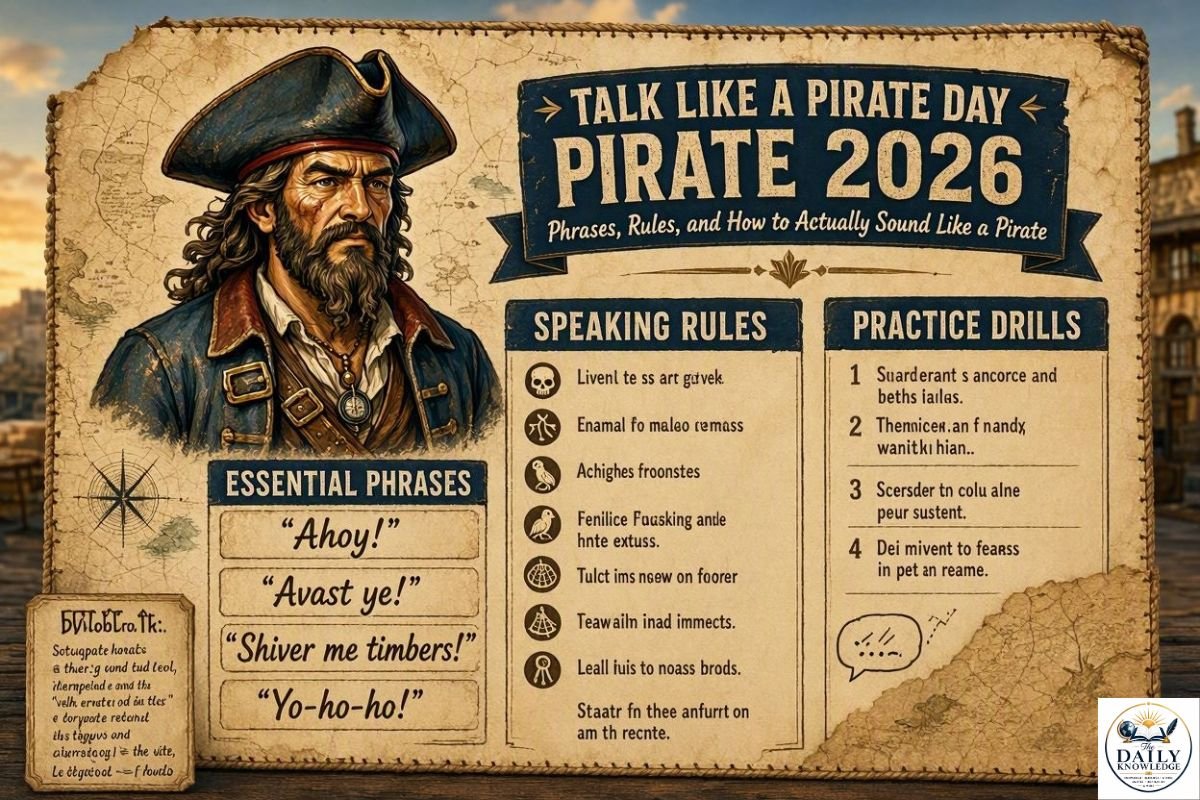
Every September 19, people around the world set normal speech aside for a day and start talking like buccaneers. Talk Like a Pirate Day 2026 falls on a Saturday, which makes it an easy one to actually plan around, whether that means a themed party, a family activity, or just dropping “arr” into casual conversation.
This guide gives you the phrases people actually use, the simple grammar tricks that make pirate speech sound consistent instead of random, and the real story behind why this slightly absurd holiday exists at all.
Where Talk Like a Pirate Day Actually Came From
The idea for Talk Like a Pirate Day was created on June 6, 1995, by two friends from Albany, Oregon, John Baur and Mark Summers. They were playing racquetball when one of them got hurt and let out an exclamation that sounded distinctly piratical, and what started as an inside joke between the two of them grew into an annual tradition. They later moved the observance to September 19 out of respect for D-Day.
The holiday might have stayed a private joke indefinitely if humor columnist Dave Barry hadn’t written about it in 2002, after Baur and Summers wrote to him suggesting he serve as the day’s official spokesperson. Barry’s column gave the idea national visibility, and the idea eventually spread beyond its original circle and became an international observance.
September 19 was chosen for a fairly ordinary reason: according to the founders, it was a date one of them could easily remember, since it happened to be his ex-wife’s birthday. The pirate accent itself, the growling, exaggerated West Country English commonly associated with pirates in film and television, isn’t drawn from historical record. It’s largely a modern popular-culture invention, shaped heavily by actor Robert Newton’s performance in the 1950 film “Treasure Island,” which became a major influence on how fictional pirates have sounded in popular culture.
The Basic Rules for Talking Like a Pirate
There’s no single historical “pirate accent” or grammar system. What follows are the modern conventions used to create the familiar pop-culture pirate voice, not a record of how real 18th-century pirates actually spoke. A few simple swaps make that pop-culture pirate speech sound consistent rather than like a random string of “arrs.”
- Replace “my” with “me.” Instead of “my ship,” say “me ship.” Instead of “my crew,” say “me crew.”
- Drop the “g” on -ing words. “Sailing” becomes “sailin’,” “plundering” becomes “plunderin’.”
- Use “ye” instead of “you.” Especially when addressing someone directly, like “What be ye doin’?”
- Add “arr” liberally. It works as agreement, frustration, excitement, or just verbal punctuation. There’s no wrong way to place it.
- Favor dramatic, nautical comparisons. Instead of “that’s a great idea,” try “that be a plan worth its weight in doubloons.”
Talk Like a Pirate Day Phrases
Ready-to-use, pirate-style lines for greetings, reactions, and general pirate flavor. These reflect modern pop-culture pirate speech rather than verified historical usage.
- Ahoy, matey! — A pirate hello.
- Avast! — Stop and pay attention.
- Arr! — All-purpose agreement, excitement, or emphasis.
- Shiver me timbers! — An expression of surprise or shock.
- Land ho! — Spotting land, or anything worth pointing out.
- Batten down the hatches! — Get ready, something’s coming.
- Walk the plank! — A playful threat.
- Yo ho ho! — A hearty, celebratory cheer.
- Ye scurvy dog! — A friendly (or not-so-friendly) insult.
- Dead men tell no tales. — A dramatic way to end an argument.
- Aye, aye, captain! — Agreement or confirmation.
- Fair winds and following seas. — A nautical-style farewell, common among sailors generally, often borrowed for pirate speech.
- I’ll keelhaul ye for that! — An exaggerated, pirate-style threat.
- Feed the fishes! — A playful pirate-style way to say someone’s in trouble.
- Hoist the colors! — A pirate-style call to get started or show your intentions.
Pirate Words You Should Know
A few nautical terms come up often in pirate speech and pirate-themed media, some rooted in real maritime vocabulary.
- Ahoy — hello or a general greeting.
- Avast — stop, or pay attention.
- Matey — friend or companion.
- Landlubber — someone unfamiliar with the sea or sailing.
- Doubloon — a historical gold coin associated with Spanish America.
- Plunder — stolen goods or treasure.
- Starboard — the right side of a ship.
- Port — the left side of a ship.
- Stern — the back of a ship.
- Bow — the front of a ship.
Pirate Speech vs. Normal English
A quick-reference table for converting everyday phrases into pirate-style speech.
| Normal English | Pirate Style |
| My ship | Me ship |
| My crew | Me crew |
| You | Ye |
| Stop! | Avast! |
| Hello! | Ahoy, matey! |
| Look at that! | Arr! Look at that! |
| Friend | Matey |
| Person unfamiliar with the sea | Landlubber |
A Sample Pirate Speech
Putting the rules and phrases together, a short pirate-style speech might sound like this:
“Ahoy, ye scurvy dogs! Batten down the hatches, for a storm be comin’ and we’ve no time to lose. Hoist the colors and set yer sights on the horizon, for treasure awaits them brave enough to sail toward it. Any landlubber who doubts me crew can walk the plank! Arr, fair winds to us all.”
How People Celebrate the Day
Beyond just talking differently for the day, people mark the occasion in a few common ways.
- Hosting pirate-themed parties with costumes, treasure hunts, or sea shanties.
- Using pirate translator tools or filters on social media to convert normal text into pirate speech.
- Reading “Treasure Island” or other classic pirate stories to get into the spirit of the day.
- Learning basic nautical directions, like starboard, port, bow, and stern, alongside the more playful vocabulary.
- Incorporating the day into classroom activities, since the playful language rules and vocabulary games make it an easy, low-stakes way to engage kids with language and wordplay.
Frequently Asked Questions
When is Talk Like a Pirate Day in 2026?
It falls on September 19, 2026, which is a Saturday. The date is the same every year regardless of the day of the week.
Why was September 19 chosen for Talk Like a Pirate Day?
The date was picked for a simple, memorable reason: it was one of the co-founders’ ex-wife’s birthdays, making it an easy date for him to remember each year.
What’s the easiest way to start talking like a pirate?
Start with the basic grammar swaps: replace “my” with “me,” drop the “g” on -ing words, and add “arr” freely. Those three changes alone make casual speech sound noticeably more piratical.
Is there an online pirate translator for Talk Like a Pirate Day?
Yes, online pirate-text generators can convert regular text into pirate-style phrasing, which can be a quick way to generate captions, messages, or party materials for the day.
Is Talk Like a Pirate Day an official public holiday?
No. It’s an unofficial, humorous observance rather than a public holiday, with no days off work or school attached. It’s simply recognized informally around the world each September 19.
Talk Like a Pirate Day started as a joke between two friends and turned into an international tradition almost by accident. Whether you fully commit to the accent or just drop a few “arrs” into casual conversation, it’s a low-effort, genuinely fun way to break up an ordinary September day.

Azrar Chattha is the founder and content creator of The Daily Knowledge. He is passionate about sharing inspiring blessings, prayers, quotes, wishes, and informative articles that educate, motivate, and bring positivity into people’s lives. His mission is to provide reliable, valuable, and easy-to-understand content that helps readers learn something new every day.
1 thought on “Talk Like a Pirate Day 2026: Phrases, Rules, and How to Actually Sound Like a Pirate ”